Enterprise AI is Dying in the "Safe Zone": A Crisis of Strategic Cowardice
Caution is no longer a strategy—it is a death sentence. While most companies treat AI as a office toy, the few who are building autonomous, agentic systems are making your business model obsolete
The "Existential Threat" (Focus on the cost of inaction)
Caution - This article is extremely provocative
There is a harsh truth emerging from the smoke of the last two years: despite a tsunami of optimism, massive capital injection, and breathless proclamations of a “new industrial revolution,” the majority of enterprises have turned Generative AI into a glorified automation toy.
And it is blowing up in their faces.
We are seeing the early signals of a massive correction—not in the technology’s potential, but in the embarrassing inadequacy of corporate adoption. The tools are god-like. The strategies are pathetic.
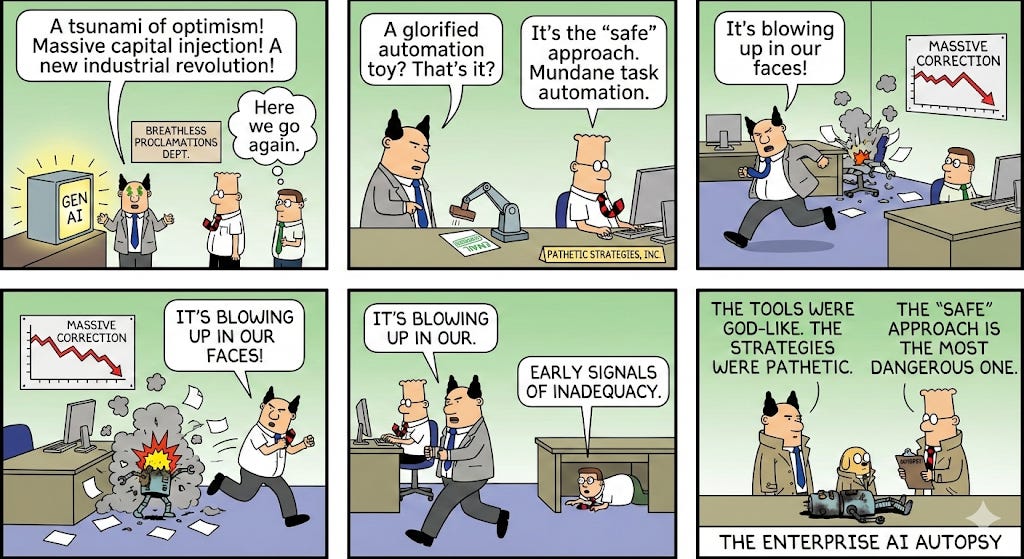
Here is the autopsy of the enterprise AI failure, and why the “safe” approach is the most dangerous one you can take.
1. Reality Check: The Failure Is Systemic
If you think your AI pilot is “just working through some kinks,” you are in denial. The failure rate is not a bug; it is the industry standard.
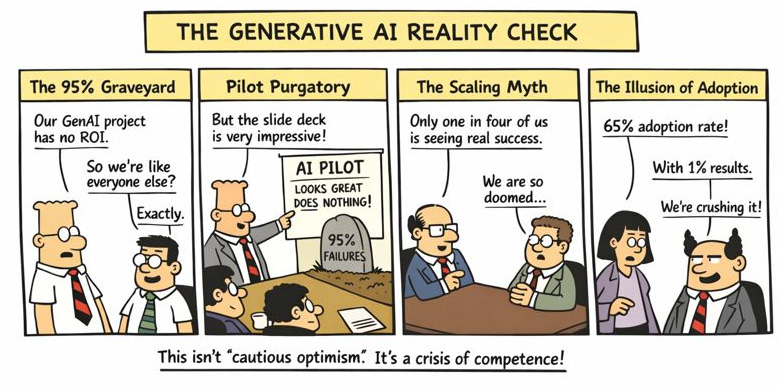
The 95% Graveyard: A recent MIT GenAI Divide study dropped a statistic that should terrify every CIO: 95% of enterprise generative AI projects deliver no measurable ROI. Not low ROI. No ROI.
Pilot Purgatory: Despite massive spending, almost the entire corporate world is stuck in “pilot purgatory”—initiatives that look busy on slide decks but don’t move the P&L needle (MLQ).
The Scaling Myth: BCG’s research shows only about one in four executives can claim their companies are seeing significant returns. The vast majority are stuck struggling to scale beyond proof-of-concepts.
The Illusion of Adoption: McKinsey notes that while “adoption” stats look high (65-88% of firms using AI), only a tiny minority have scaled it meaningfully. Most are seeing single-digit percent improvements.
This isn’t “cautious optimism.” It is a crisis of competence.
2. The Root Problem: Weak Thinking
Here is the brutal truth leaders are afraid to admit: Generative AI isn’t failing. Traditional corporate strategy is.
Leaders have collectively chosen to use a nuclear reactor to power a toaster. They have opted for:
Low-effort, low-impact automation.
Bright, shiny pilots that look good in quarterly reviews but never scale.
BAU (Business As Usual) enhancements that barely move metrics.
The default playbook is embarrassing: Automate email. Add a chatbot. Slash a tiny headcount in customer support.
This is bringing a scalpel to a battlefield. You aren’t reinventing the business; you are just making your mediocrity slightly faster.
3. The Conspiracy of Silence: The Analyst Industrial Complex
Why aren’t you hearing this from the big research firms? Why does every report you pay $50,000 for tell you to “accelerate adoption” rather than “stop the bleeding”?
Because confusion is their business model.
The Industrial Analyst Complex (Gartner, Forrester, and their kin) has been suspiciously silent about the structural failure of GenAI adoption. Why? Because they profit from the hype cycle.
Phase 1 (The Hype): They sell you the “Transformation Guides” and “Maturity Models” to get you into the game, fueling the FOMO that leads to bad strategy.
Phase 2 (The Silence): As projects fail (the current 95% reality), they stay quiet to keep the consulting fees flowing. If they admitted the tools don’t work the way they promised, the budget spigot would dry up.
Phase 3 (The pivot): They are waiting for the crash so they can sell you the “Correction Reports.” They will sell you the solution to the problem they helped create.
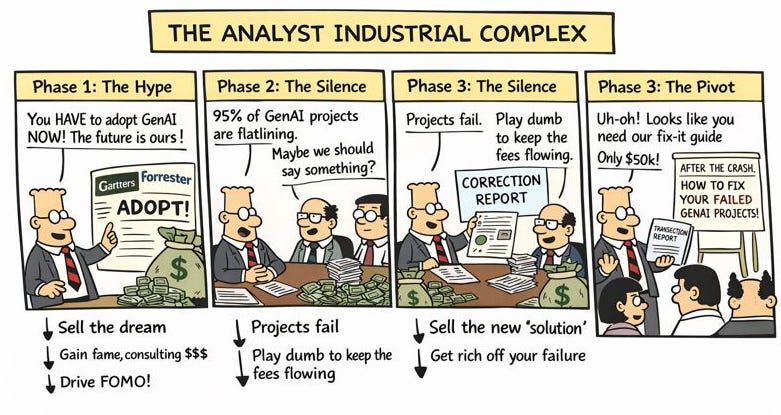
Can we raise a red flag here? These firms are supposed to be the lighthouses of the industry. Instead, they are just selling tickets to the shipwreck. They are waiting to monetize the cleanup rather than offering honest technical reporting now.
4. Enterprise Strategy Is Playing in the Kiddie Pool
While GenAI unlocks the computational capacity for massive simulation, cross-domain orchestration, and black-swan mitigation, most enterprises are still asking, “Can it write this marketing email for me?”
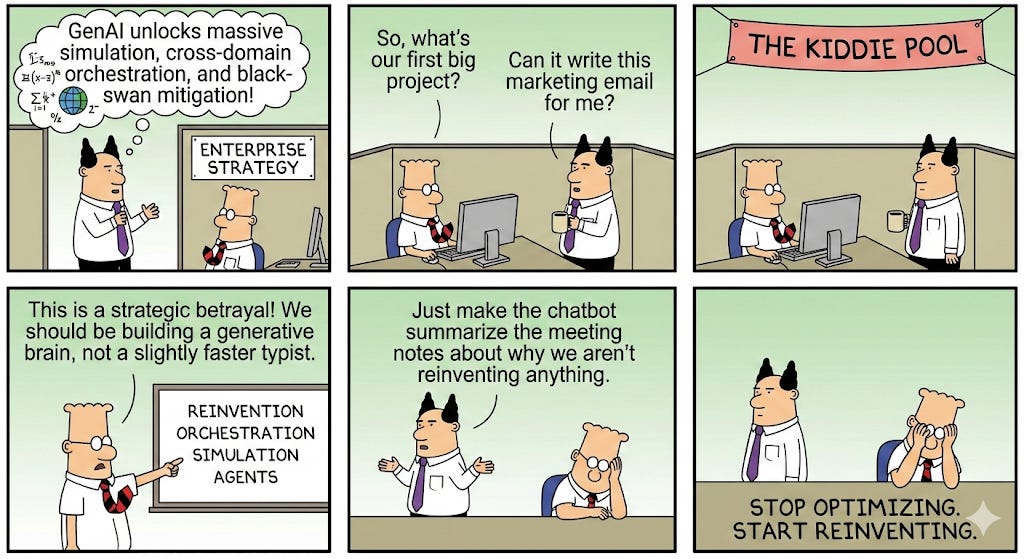
This is a strategic betrayal of the technology.
If you want to survive the next five years, you need to stop optimizing and start reinventing:
⚡ Blue Ocean Reinvention: Don’t use AI to cut costs in your dying business model. Use it to engineer entirely new value chains that were impossible before.
⚡ The Orchestration Plane: Connect R&D, supply chain, pricing, and risk into one generative brain. If your AI is stuck in a silo (marketing vs. HR), it is useless.
⚡ Black Swan Simulation: AI can run near-real-time simulations of economic shocks, regulatory disruptions, and supply chain collapses. Why are you not building this?
⚡ Autonomous Agents: Move from “Chatbots that talk” to “Agents that do.” We need systems that execute decisions end-to-end, not just summarize meeting notes.
5. The Trillion-Dollar Opportunity Cost
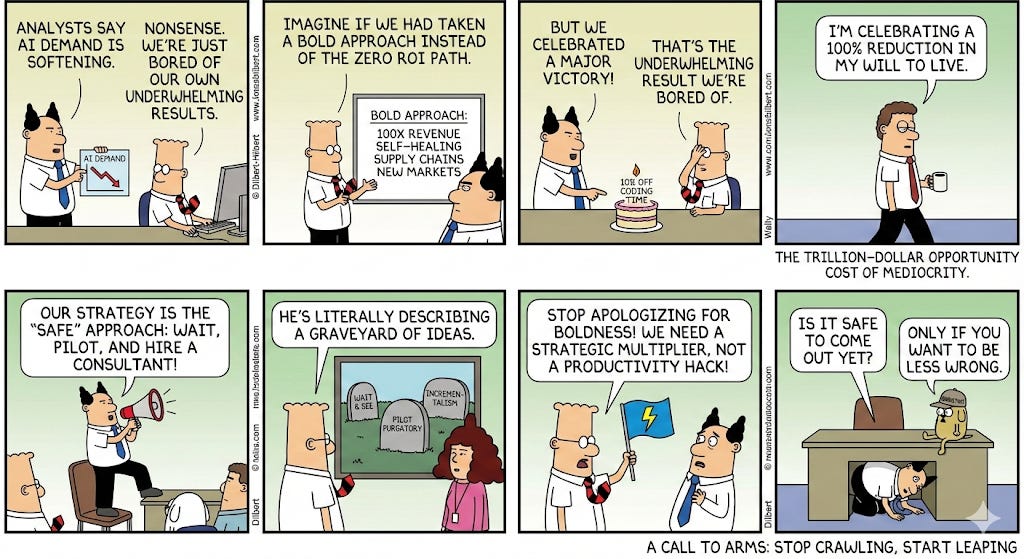
Analysts are seeing signs that AI demand is “softening.” This is nonsense. Demand is softening because enterprises are bored of their own underwhelming results.
Imagine if the 95% of companies with zero ROI had taken a bold approach:
Revenue Growth: Not 5%, but 2 orders of magnitude.
Resilience: Supply chains that self-heal before a disruption hits.
New Markets: Entire product lines engineered by AI insights in weeks, not years.
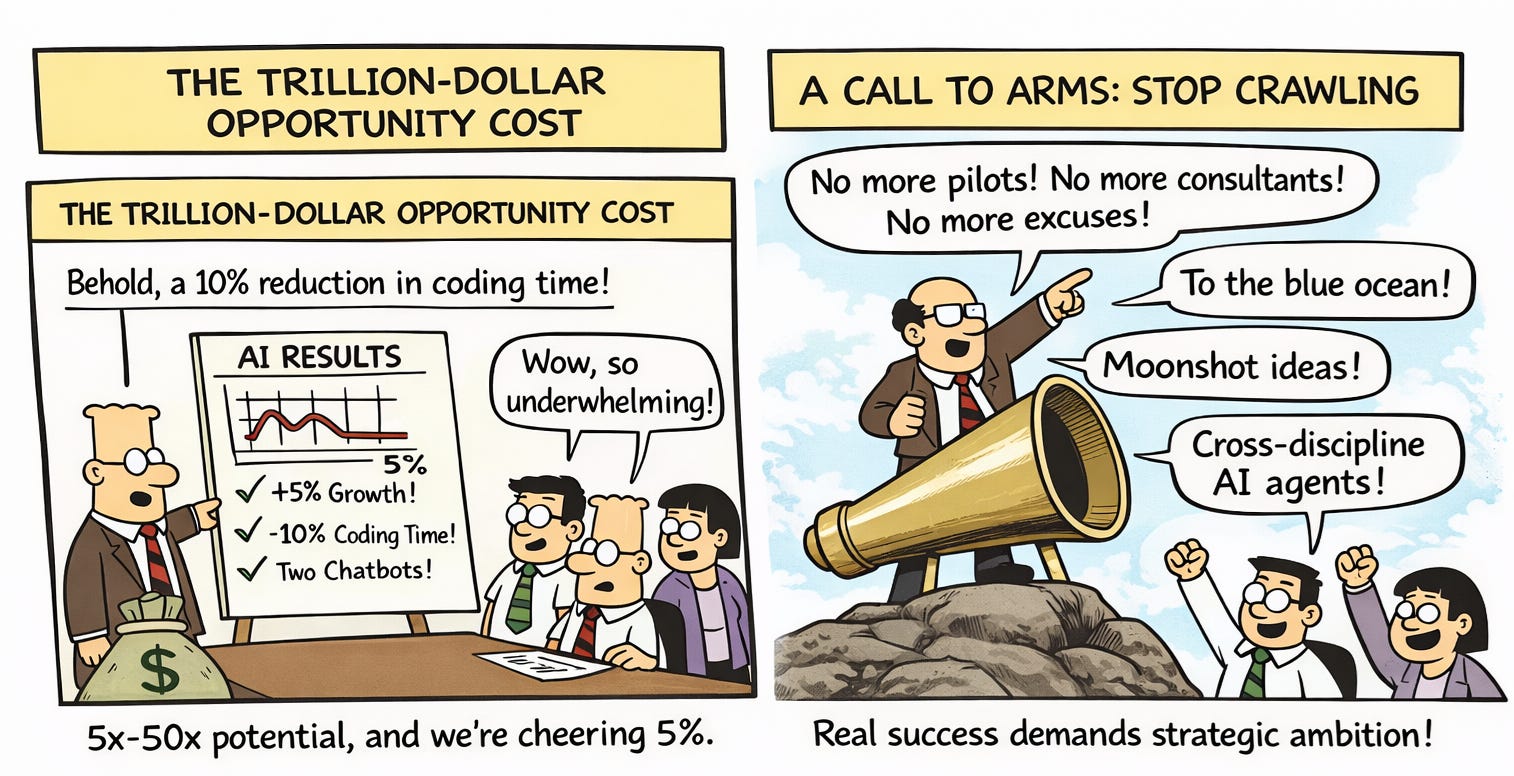
We are talking 5x–50x value. Yet most of you are still celebrating a 10% reduction in coding time.
6. A Call to Arms: Stop Crawling
The future belongs to those who treat Gen AI not as a productivity hack, but as a strategic multiplier.
The “safe” approach—wait and see, run a pilot, hire a consultant—is now the riskiest path available. The current enterprise mindset is a graveyard of incrementalism.
Stop apologizing for boldness. Real GenAI success will not come from being “less wrong.” It will come from being vastly more ambitious.
Used Generative AI (ChatGPT and Gemini) for comic strips creation - Thanks
References:
MIT GenAI Divide Report (2025) - The “95% Failure” statistic.
BCG Global Research - “From Potential to Profit with GenAI.”
McKinsey & Company - “The State of AI in 2025” (Adoption vs. Scaling).
Goldman Sachs - “Gen AI: Too Much Spend, Too Little Benefit?” (The macro critique).
Hashtags: #GenAI #EnterpriseStrategy #DigitalTransformation #ArtificialIntelligence #BusinessStrategy #TechBubble #CIO #FutureOfWork #AIAdoption #Contrarian #Provocative

No comments:
Post a Comment